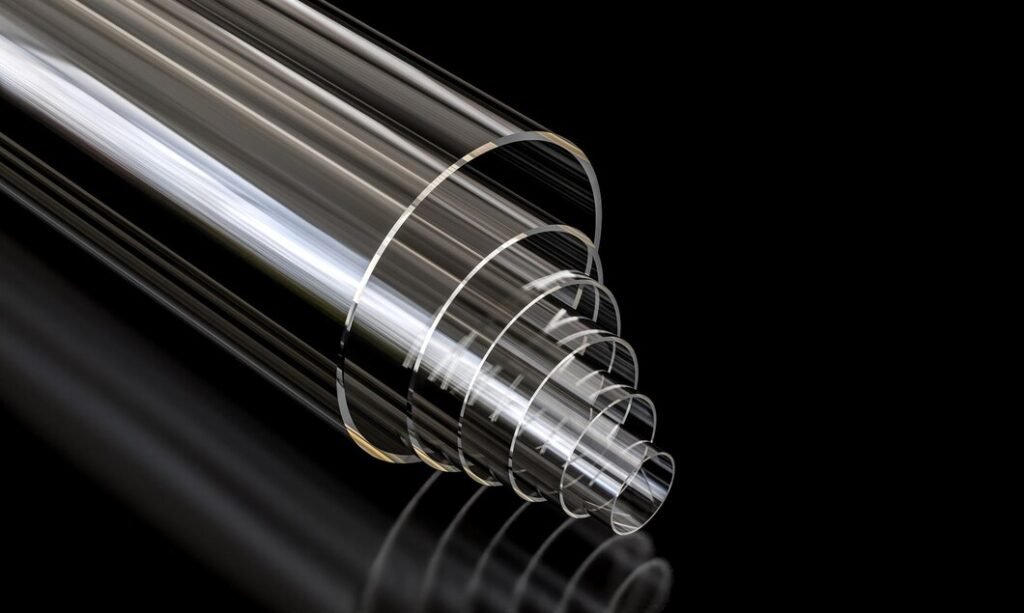
Why Thickness Selection is Critical
Most buyers focus on diameter—but in real applications, failure happens due to wrong thickness, not size.
Acrylic pipe thickness directly affects:
- Pressure resistance
- Structural stability
- Long-term durability
Wrong selection = cracks, deformation, or failure under load.
The Core Principle (Simple but Powerful)
Thickness depends on two real factors:
- Internal Pressure (force from inside)
- Flow Behavior (steady vs fluctuating)
Higher pressure or unstable flow = thicker wall required
Quick Selection Logic (Industry Shortcut)
Low Pressure Applications
Examples: fountains, aquariums, gravity flow
- Use standard wall thickness
- Focus more on transparency than strength
 Cost-effective
Easy to fabricate
The Core Principle (Simple but Powerful)
Thickness depends on two real factors:
- Internal Pressure (force from inside)
- Flow Behavior (steady vs fluctuating)
Higher pressure or unstable flow = thicker wall required
Quick Selection Logic (Industry Shortcut)
Low Pressure Applications
Examples: fountains, aquariums, gravity flow
- Use standard wall thickness
- Focus more on transparency than strength
Cost-effective
Easy to fabricate
Moderate Pressure Applications
Examples: water circulation systems, aquaponics
- Use medium wall thickness
- Balance between strength and clarity
✔ Stable performance
✔ Reduced risk of stress cracks
High Pressure Applications
Examples: industrial fluid transfer, chemical lines
Prevents bursting
Handles pressure fluctuations
Flow Type Matters More Than You Think
Two systems with the same pressure can behave differently:
- Steady Flow → Lower stress
- Pulsating Flow → High stress impact
Pulsation (from pumps or valves) requires extra thickness buffer, even at moderate pressure.
Common Mistakes to Avoid
Choosing based only on diameter
Thickness is what handles load, not diameter
Using thin pipes for visual clarity
Transparency should never compromise strength
Ignoring joint stress
Most failures happen at connections, not in straight pipes
Practical Selection Rule
Use this simplified approach:
- Decorative / low load → Thin to standard thickness
- Functional + moderate load → Medium thickness
- Industrial / high pressure → Heavy-duty thickness
When in doubt, always slightly over-specify thickness for safety.
Conclusion
Acrylic pipe performance is not about how it looks—it’s about how it handles pressure over time. Diameter co
ntrols flow Thickness controls survival Choosing the right thickness ensures:
Longer life
Safer operation
Lower maintenance



 Cost-effective